
There is a persistent assumption among Malaysian founders and business owners that raising equity is the default move when capital is needed. You bring in investors, give up a slice, and use the cash to grow. Clean. Simple. Familiar.
It is also frequently the wrong structure.
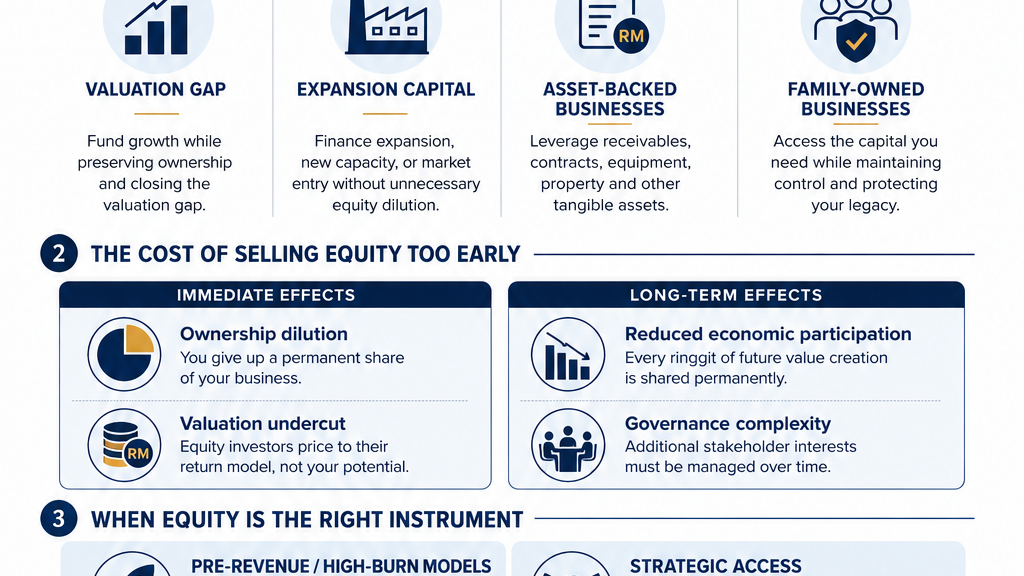
Equity is permanent. Every ringgit of equity sold today permanently shares future value creation with another shareholder. Whether that trade is worthwhile depends on what the investor contributes beyond capital.
The Businesses Where Debt Wins
The case for debt over equity is strongest in these situations.
1. You have revenue but a valuation gap
If your business generates RM3–5 million in EBITDA but your sector trades at a low multiple, equity investors will reprice you to fit their return model. You sell 30% and get less than you think you deserve. Debt keeps the ownership intact while allowing you to fund the growth that closes the valuation gap before you consider any equity event.
2. You need expansion capital, not transformation capital
Opening a second manufacturing line, entering a new distribution territory, or funding a contract that requires upfront procurement: these are cash timing problems, not equity events. A well-structured term loan, revolving credit, or mezzanine facility solves this without dilution.
3. Your business is asset-heavy
Malaysia's banking ecosystem offers facilities for businesses that can present their financials correctly. But most SMEs never access this capacity because their accounts, governance, and repayment models are not structured for a credit committee.
If you have receivables, equipment, property, or government contracts, you have collateral, and it is often underutilised. Many SMEs in logistics, construction, manufacturing, and trading sit on debt capacity they have never accessed. They raise equity instead because they do not know how to structure their balance sheet for a credit application.
4. You are a family-owned business that genuinely cannot afford to lose control
There are Malaysian family businesses where fractional dilution to an outside investor is not a governance discussion. It is an existential one. For these businesses, debt is not a second-best option. It is the only option that preserves what the business actually is.
When Equity Is Actually Right
Equity has a proper place.
If your business model requires funding that the cash flows cannot service (genuinely pre-revenue, platform-dependent, requiring three to five years of losses before unit economics improve), debt creates a repayment burden that will constrain or destroy the business. That is when equity is the correct instrument.
Equity is also appropriate when what you are buying is not just capital but access: a strategic investor who opens distribution channels, unlocks regulatory relationships, or repositions the business for a cross-border transaction. In those cases, the dilution is the price of the strategic value, not just the capital.
But that is a specific, deliberate decision. It is not a default.
What I Keep Seeing in the Market
Over the years, I have noticed that the financing mistakes founders make are surprisingly consistent. The details change. The underlying error usually does not.
The manufacturer who sold equity to solve a cash flow problem
A profitable contract manufacturer, with plant, equipment and established MNC buyer relationships, wanted to fund a second production line. Real business case. Serviceable numbers.
Someone introduced a "strategic investor." Industry connections were mentioned. Potential off-take agreements. Regional access. The founder took the meeting and spent two months negotiating equity term sheets. The investor wanted 35% for a capital injection that a hire-purchase facility against the new equipment and a revolving credit line against existing receivables could have covered, without surrendering a single share.
We restructured the approach. The debt facility was arranged. The expansion proceeded.
But not every founder catches this before signing. The ones who do not end up with a permanent co-owner acquired at a moment of temporary cash pressure, and a minority shareholder who, eighteen months later, is exercising information rights and creating friction on dividend policy. The governance problem outlasts the capital problem by years.
The trading business that mispriced its own equity
A trading and distribution company, with RM8 million in revenue, government-linked buyers, thin margins and high volume, needed RM1.5 million to fund working capital for a new contract. They came to market seeking equity.
By the time they approached us, they had already spent three months negotiating equity term sheets for a problem that a purchase-order financing facility could have solved. At a 4x earnings multiple on a 5% net margin business, raising RM1.5 million in equity would have required giving up nearly half the company. Two term sheets had already been declined, not because the terms were unreasonable, but because the founder could not stomach the dilution.
The actual solution was contract financing against the government purchase order. The credit assessment shifted to the buyer's creditworthiness, not the company's balance sheet. The facility was arranged in six weeks. No dilution. No co-owner. No governance friction.
The capital was available the entire time. Three months were lost because the first question asked was "who will invest in us" rather than "what does our balance sheet already support."
The technology platform that confused investors for partners
An omni-channel retail technology company, asset-light, with government partnerships and real commercial traction across mall operators and established brands, needed growth capital to scale its platform regionally.
For a business of this profile, equity was genuinely the right instrument. No hard collateral, long enterprise sales cycles, early-stage revenue. Debt would have been the wrong structure. That was not the mistake.
The mistake was treating the fundraise as a funding exercise. Investors were evaluated on cheque size. One investor had retail experience. Another had capital. Neither could open doors to the enterprise customers the company was actually targeting. The founders raised money, but they did not materially improve their probability of winning the next hundred customers, which was the only thing that mattered at that stage of the business.
Eighteen months in, shareholders who had been sold a regional expansion story were pushing for near-term revenue. The timeline mismatch was not a surprise. It was visible in the term sheets from day one, had anyone mapped investor incentive structures against the business cycle before closing.
When equity is the right instrument, the wrong equity partner is still an expensive mistake.
What Founders Often Miss
The mistake is not choosing debt or choosing equity. The mistake is treating capital raising as a funding exercise.
In reality, it is a balance sheet exercise.
Investors, lenders, strategic partners, and acquirers all look at the same business through different lenses. A bank credit committee reads your receivables ageing and debt service coverage ratio. A private equity investor reads your EBITDA margin and exit optionality. A strategic partner reads your customer concentration and market positioning. None of them are evaluating the same thing.
Most founders ask:
"Who can give me RM5 million?"
The better question is:
"Which capital provider is best aligned with the risk profile of what I am trying to achieve, and what does my balance sheet need to look like before that conversation starts?"
That distinction changes not just the outcome of the fundraise. It changes the quality of the relationship that follows, the governance structure the business operates under for the next five to ten years, and whether the founder is still in control when the business reaches the value it was always capable of.
The capital structure decision is not administrative. It is strategic. And in most cases I have seen, it is made too quickly, with too little analysis, under time pressure that was itself a consequence of not planning the balance sheet early enough.
The Structural Question
The honest reason many founders end up raising equity is not that equity is optimal. It is that they tried to access debt, could not qualify, and treated the rejection as proof that debt was not an option. It was not. The rejection was a balance sheet problem: unaudited accounts, financials that do not map to what a credit committee reads, informal governance, no articulated repayment model.
That is a solvable problem. But it requires deliberate work on the business's financial infrastructure before approaching any capital provider.
The capital structure conversation should always start with the same question:
What does this capital need to do, over what time horizon, and what is the cost, fully modelled, of each option?
Founders who answer that question carefully often discover that debt is not merely cheaper. For certain business models, it is the more appropriate instrument.
Debt and equity are not competing products. They are different instruments designed for different risk profiles. The objective is not to prove that one is superior to the other. The objective is to ensure that the capital structure matches the economics, risk profile, and strategic objectives of the business.
← All Capital Insights