Every transaction I've worked on, whether buy-side, sell-side, restructuring or a straight capital raise, eventually comes back to the same four questions.
- How do we create value?
- How do we finance it?
- Who controls what we create?
- How do we realise it?
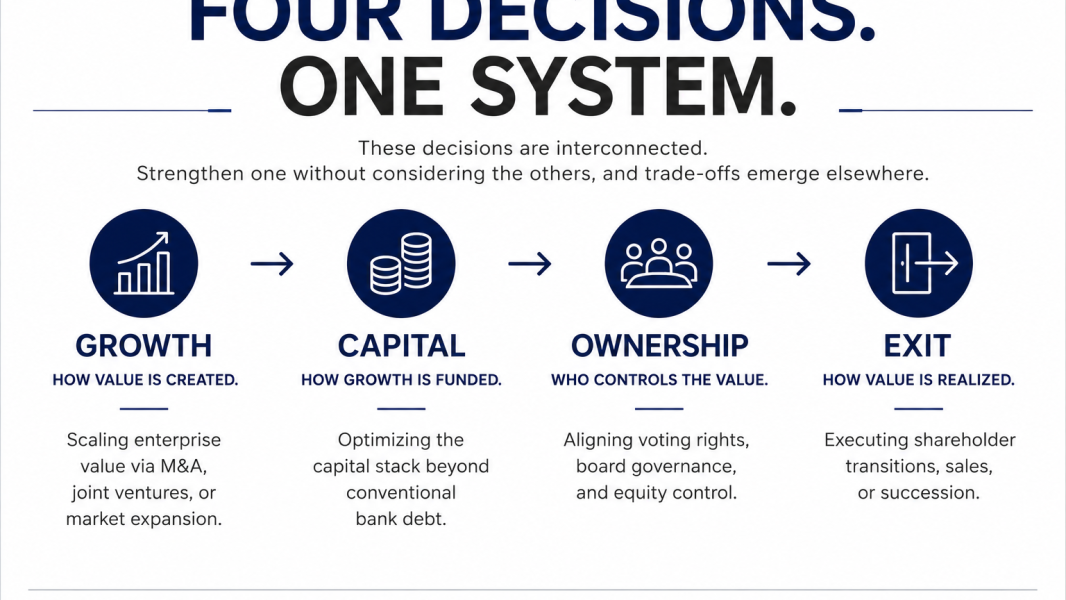
Practitioners shorthand this as Growth, Capital, Ownership, Exit. Most owners treat these as four separate problems that show up whenever they show up. They're not separate. They're one problem with four faces. Ignore one and the other three degrade with it.
Growth receives the most attention because it is the most visible decision. It is also the most continuous one. Expand, partner, acquire, or hold: these are decisions that get revisited every quarter rather than once in a corporate lifecycle.
Capital is where the story most owners are running is out of date. The claim that Malaysian businesses can't access funding stopped being accurate years ago. Banks approved close to 80% of SME financing applications in the first five months of 2026. What hasn't changed is the type of capital on offer. Most mid-market owners are building their entire capital stack on bank debt, because debt is the only instrument anyone has offered them. Malaysia's venture capital and private equity funds ended last year with roughly RM30 billion in committed capital. Only about RM2.8 billion of it was deployed during the year. The issue is increasingly one of structuring, readiness and alignment, not the absolute availability of money.
Ownership is the pillar owners like formalising least while the business is still working. Who holds equity, who controls voting rights, what happens when an institutional investor wants in: these get settled informally, on trust, until the business outgrows informal. By then it's a negotiation under pressure, not a decision made on your own terms.
Exit is where the numbers are hardest to argue with. Most founders I meet acknowledge succession is important. Very few have actually planned for it. Only about a quarter of family businesses in the region have a robust, documented succession plan, and surveys of Malaysian family firms have put it closer to one in seven. That gap doesn't close on its own. It gets closed by an illness, a death, or a dispute between siblings who were never handed a governance structure to work from. I've advised on the version where it was planned, and the version where it wasn't. The difference in outcome is not subtle.
None of these four are optional. They arrive whether or not the owner has prepared for them. The only real choice is who's making the decision when they do: the owner, or a bank's risk committee, a sibling's lawyer, or a buyer who already knows you're out of options.
By the time these decisions become urgent, someone at the table has usually already understood the implications. The outcomes tend to favour the party who saw them earlier.
← All Capital Insights