
One of the most expensive mistakes I see founders make is assuming that bringing in an outside investor is primarily a funding decision.
It isn't. It is one of the most important capital allocation decisions a founder will ever make.
Yet the conversation almost always begins with ownership.
"How much of my company will I have to give away?"
It should begin somewhere else.
"What does this capital allow my business to become?"
Those are fundamentally different questions.
A founder who gives up 20% of the company to solve a short-term cash flow problem has made a very different decision from a founder who gives up the same 20% to expand into new markets, acquire a competitor, build a defensible technology platform, or reach pre-IPO scale.
The dilution is identical. The economic outcome is not.
Founders often view dilution as a cost. Sophisticated investors view it as capital allocation. That difference explains why many fundraising discussions fail before valuation is even negotiated.
Every new share issued transfers part of the company's future economic value. The relevant question is not whether dilution occurs. It is whether the capital being raised creates more enterprise value than the ownership being surrendered.
If RM10 million enables the business to create RM100 million of additional enterprise value, dilution may prove inexpensive.
If the same RM10 million merely extends survival for another twelve months without fundamentally improving the business, even a relatively small equity raise may become one of the most expensive financing decisions the founder ever makes.
The percentage is rarely the real issue. The use of capital usually is.
Start with the Financing Instrument
Once founders decide they need capital, many immediately begin looking for investors. That assumption deserves to be challenged.
Needing capital does not automatically mean needing equity.
In Malaysia, most SME founders already understand this instinctively. Their first conversation is usually with a bank, not an investor. Working capital facilities, trade financing, receivable financing, asset-backed lending, or other forms of structured debt are often explored before equity enters the discussion.
That sequencing is generally correct.
Equity is permanent capital. Once new shares are issued, they cannot simply be repaid when the financing problem disappears. Every share participates in every future dividend, every future acquisition, and every eventual exit.
That is why equity should generally finance permanent value creation, such as market expansion, acquisitions, technology investment, succession transitions, or transformational growth. It should not finance temporary liquidity problems that conventional debt was designed to solve.
The objective is not to avoid equity. It is to use the most appropriate financing instrument for the problem being solved.
Timing Is Part of the Financing Decision
Even when equity is the appropriate instrument, timing matters.
Many founders negotiate intensely over valuation while overlooking the single variable that influences valuation the most: business performance.
Sometimes six months of disciplined execution creates more shareholder value than six months of negotiation.
- A stronger customer base
- Higher margins
- Recurring revenue
- A marquee customer
- Better governance
- A cleaner balance sheet
Each milestone can materially improve investor confidence before a single new share is issued.
But this assumes timing is a choice. For many founders, it isn't.
- Succession planning
- Partner buy-outs
- Founder liquidity
- A major acquisition opportunity
- A balance sheet under pressure
These situations often impose a timetable the founder cannot control.
When timing is forced rather than chosen, the discussion changes. It is no longer about waiting for a better valuation. It becomes about negotiating a better structure.
- Milestone-based investment tranches
- Earn-outs
- Phased investments
- Clearly defined governance rights
Experienced founders optimise governance before they optimise valuation.
The best negotiation often happens before fundraising begins. When it cannot, the best protection is built into the transaction itself.
Choose the Capital Partner Before Negotiating Valuation
Many founders negotiate aggressively over valuation while paying surprisingly little attention to the investor sitting across the table.
Valuation affects today's cap table. The capital partner may influence the company's trajectory for the next decade.
The right investor contributes more than capital. They:
- Open markets
- Strengthen governance
- Improve institutional credibility
- Support future fundraising
- Challenge management constructively
- Help navigate difficult strategic decisions
The wrong investor can do exactly the opposite.
Not all capital creates equal value. The cheapest capital is not always the least dilutive. Sometimes it becomes the most expensive.
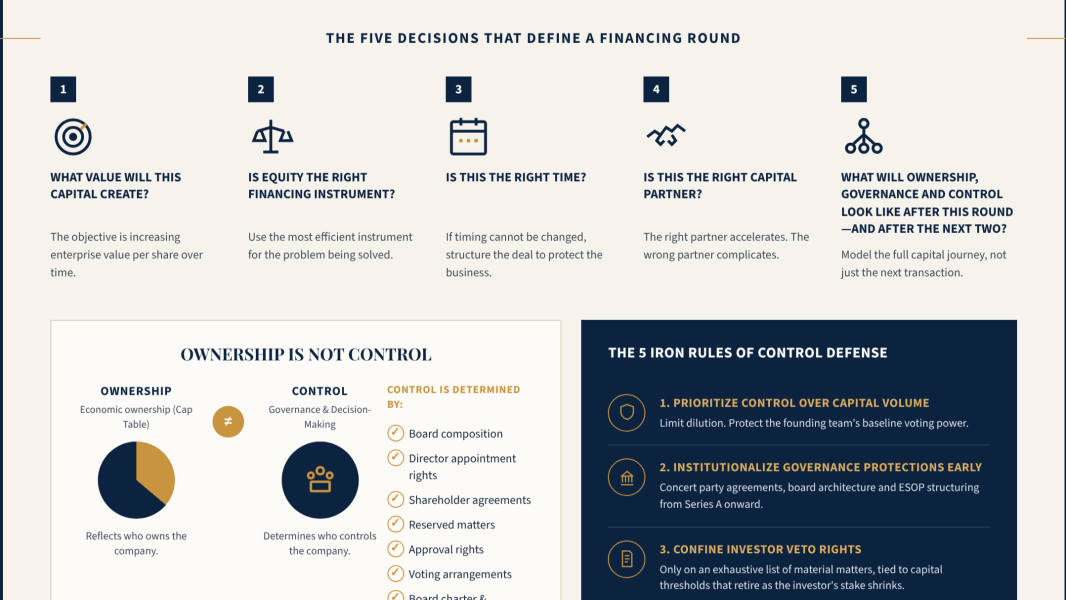
Ownership Is Not the Same as Control
This is where many founders misunderstand dilution.
The cap table records economic ownership. It does not determine who controls the company.
Control is established through governance:
- Board composition
- Director appointment rights
- Shareholder agreements
- Reserved matters
- Voting arrangements
- Approval thresholds
These provisions often receive less attention than valuation during negotiations. Yet they frequently become the terms that matter most after the investment closes.
Sophisticated founders distinguish between economic ownership and voting control. They are related. They are not identical.
The regional capital markets provide useful examples.
Grab's founder, Anthony Tan, owned only a relatively small economic interest by the time the company became publicly listed. Yet through a carefully designed governance structure established before listing, he retained decisive voting control. In early 2022, he and his related entities owned about 3.6% of Grab's shares but controlled roughly 62% of the voting power. The lesson is not that every founder should adopt dual-class voting structures. The lesson is that governance architecture matters just as much as ownership percentage.
The opposite lesson can also be observed.
Corporate governance is rarely tested when business performance is strong. It is tested when difficult decisions must be made.
When boards become divided, investors disagree with management, or financial performance deteriorates, governance, not economic ownership, often determines who ultimately controls the outcome.
Founders therefore need to evaluate more than today's dilution.
Ownership compounds. So does governance.
A financing round that appears reasonable today may produce a very different outcome after another two or three rounds.
The best financing decisions are evaluated across the company's expected capital journey, not one transaction at a time.
The Real Decision
When founders ask, "How much equity should I give away?", they are usually asking the wrong question.
The better questions are:
- What value will this capital create?
- Is equity the most efficient financing instrument?
- Is this the right time to raise equity?
- If timing cannot be changed, what transaction structure best protects the business?
- Is this the right capital partner?
- What will ownership, governance and control look like after this round, and after the next two?
Viewed individually, each question seems straightforward. Together, they determine whether bringing in an outside investor strengthens the business or merely changes who owns it.
In corporate finance, dilution is neither inherently good nor inherently bad. Avoiding dilution is not the objective.
Maximising enterprise value per share while preserving sufficient ownership and governance to execute the company's long-term strategy is.
The founders who consistently build valuable companies rarely optimise a single financing variable. They optimise the entire capital allocation decision.
Situation Signal
After enough transactions, a pattern begins to emerge.
The founders who lose control of their companies are rarely those who accepted the highest dilution.
More often, they are the ones who negotiated valuation before financing strategy, ownership before governance, and capital before control.
By the time those distinctions become important, the transaction has already closed.
And by then, the cap table is simply reflecting decisions that were made much earlier.
← All Capital Insights