
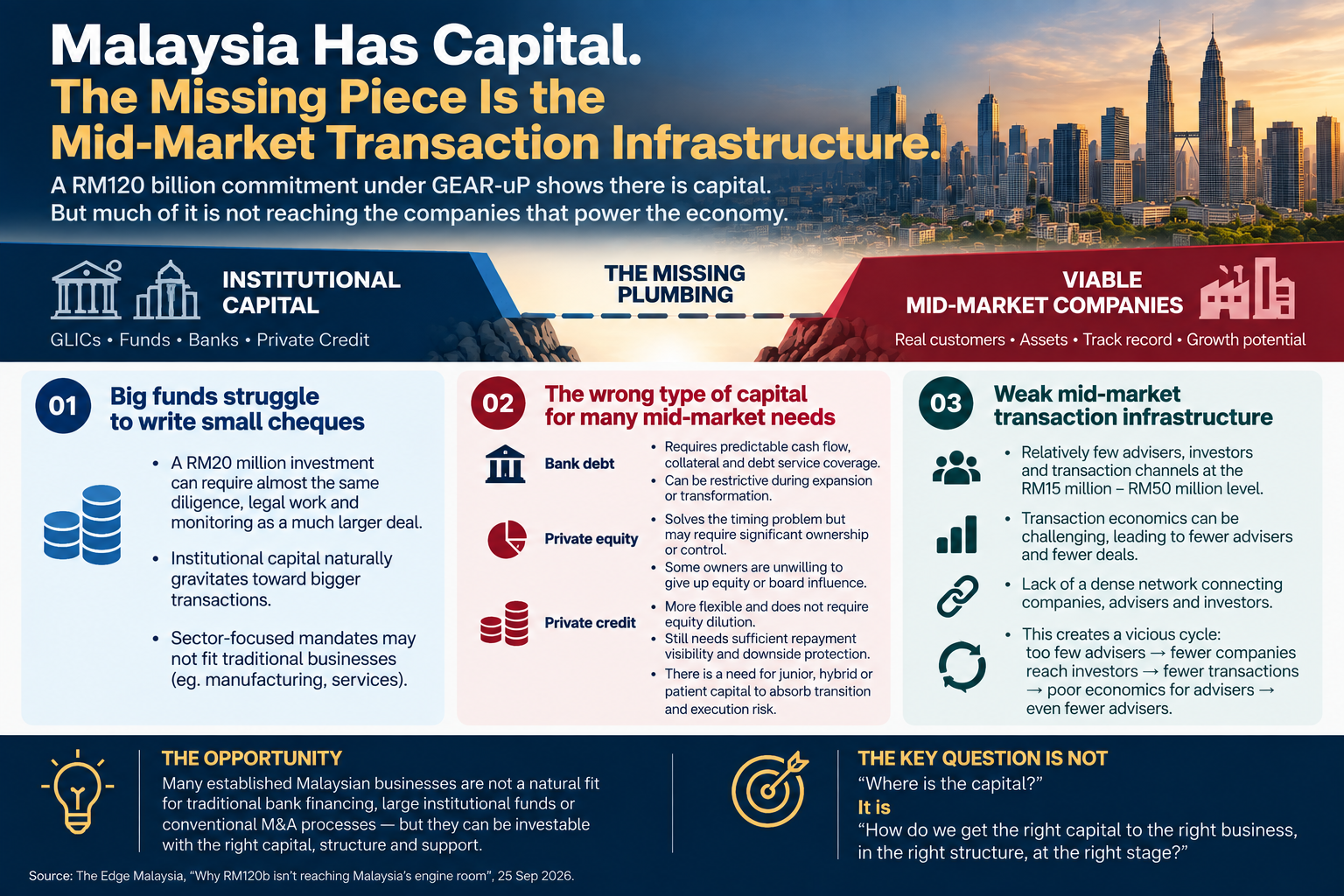
Krystle Chan and Pearl Lee's opinion piece in The Edge, "Why RM120b isn't reaching Malaysia's engine room," is one of the clearest recent explanations of why mid-tier companies struggle to raise capital. Krystle is a finance professional with experience across investment banking and public markets, and Pearl is an investment professional with experience across real estate and private credit.
Read the original article: Why RM120b isn't reaching Malaysia's engine room (The Edge Malaysia)
Their argument in short: the money is there, but it isn't reaching the companies. Large funds find RM20 million cheques uneconomic. Bank debt, private equity and private credit each fit transforming companies poorly. And too few advisers work the RM15 to 50 million range to connect companies with capital.
All three bottlenecks are real. There is a fourth, and it sits underneath the other three.
Most mid-tier companies have never been shown an exit.
Every Investor Is Buying an Exit
An equity investor isn't buying a share of profits. A RM20 million minority stake in a private manufacturer won't pay back through dividends on any timeline a fund can accept. The return comes when someone else buys that stake, through a listing, a trade sale or a secondary sale to a larger investor.
So before an investor asks about margins, customers or the automation plan, the real question is simple:
Who buys this from me, and when?
If the founder can't answer, the investor prices in the uncertainty. That means a lower valuation, heavier protections, or no deal. Founders read this as investors being difficult. It's investors being rational about capital with no visible way out.
Notably, the listing route was built into GEAR-uP from the start. When the programme was announced, the Ministry of Finance said the investments would cover businesses at every stage, from startups and venture capital to mid-tier companies, and would also support the eventual listing of those companies. The exit isn't an afterthought to the policy. It's part of the design.
The Exit Fixes the Other Three Bottlenecks
Cheque size. A large fund avoids a RM20 million deal because the work is almost the same as a RM200 million deal and the upside is limited. Put a credible listing two to three years out and the maths changes. The investor enters at a private valuation and exits at a listed one, and that gap is the return. The same RM20 million cheque now carries a multiple that justifies the diligence.
The instrument. Private equity is often resisted because it demands equity and control. Investors ask for board seats, veto rights, put options and drag-along clauses because, without a visible exit, those rights are the only way to force one. Control is a substitute for liquidity. Show a credible route to liquidity and the protection package gets lighter. Founders keep more of their company when investors can see their own way out.
The advisory gap. A single RM15 to 50 million raise doesn't pay an adviser for the work involved. A company on a listing pathway isn't one transaction, though. It's a sequence: restructuring, a pre-listing round, the listing itself, and often acquisitions afterwards. Economics that fail for a one-off raise work across the whole pathway. Advisers follow pathways, not one-offs. That's how the middle gets rebuilt.
What a Credible Exit Looks Like
It isn't a slide that says "IPO in 2028." Every investor has seen that slide. A credible pathway is one an investor can test.
It starts with financials that hold up under audit, with related-party dealings cleaned out. The group structure has to make sense to an outsider: a clear holding company, operating subsidiaries, and no personal assets mixed into the business. Management has to run the company without the founder in every decision. There should be some independent voices on the board before the investor arrives, not after.
Then comes the venue. Choose it for the business, not for convenience. Bursa is the right home for many companies. Others find a deeper investor base and better comparables in Australia or the US. That choice isn't a detail to settle later, because it shapes which investors come in today and at what valuation.
Finally, the timeline. It needs milestones, not just a target date. Investors back a sequence they can track.
None of this is paperwork for its own sake. Every item either raises the valuation or removes a reason for the investor to discount it.
The Succession Clock Is Running
As the authors point out, many of Malaysia's strongest mid-market companies were built during the manufacturing and export boom of the 1980s and 1990s, and their founders are now approaching retirement.
For them, the exit question is no longer theoretical. A listing or a structured sale is the succession plan. A founder who starts preparing at 60 chooses the route. A founder who starts at 70 takes whatever route is left.
Ask the Exit Question First
Most founders start with one question: how much can I raise?
The better first question is:
Who eventually buys this, and what will they need to see?
Answer that, and the capital question gets easier. The right investor shows up, the instrument fits, and there are fewer strings attached.
Malaysia has mobilised the capital. The next job is building the exits that make it worth deploying.
Capital follows trust. Nothing builds investor trust faster than a visible way out.
Weighing a capital raise, a sale or a listing? Start with the exit question.
← All Capital Insights