
Many founders assume fundraising failure is caused by weak financials, poor timing, or an imperfect pitch deck.
More often, the real issue is a fundamental misunderstanding of how capital evaluates businesses.
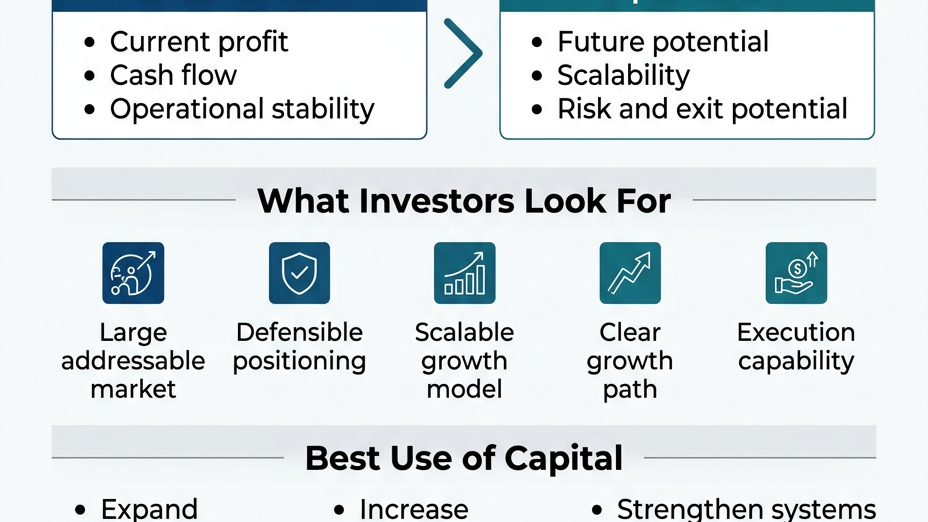
Investors do not simply buy current profitability. They buy future enterprise value.
That distinction explains why some profitable companies struggle to raise capital, while less profitable competitors attract institutional interest at significantly higher valuations.
The issue is not whether the business works. The issue is whether the business is perceived as scalable, defensible, transferable, and capable of compounding value over time.
Profitable Is Not the Same as Investable
A profitable company proves operational viability. An investable company proves future strategic value.
These are not the same thing.
Founders evaluate with business logic
- Revenue growth
- Profit margins
- Cash flow
- Operational efficiency
Investors assess
- Scalability
- Market positioning
- Governance quality
- Management depth
- Execution capability
- Defensibility
- Capital efficiency
- Exit potential
- Downside protection
From a founder's perspective, profitability validates success. From an investor's perspective, profitability alone may simply indicate a business with limited scalability and a visible growth ceiling.
This is why many healthy SMEs remain difficult to finance through equity markets despite generating stable earnings.
The business may be profitable. But the enterprise may not yet be institutionally investable.
Business Value vs Capital Value
This is one of the most misunderstood distinctions in fundraising.
Business Value is based on what the company earns today. Capital Value is based on what the market believes the company can become tomorrow.
A founder sees
- Strong monthly cash flow
- Loyal customers
- Stable operations
- Years of hard-earned execution
An investor sees
- Total addressable opportunity
- Scalability of the model
- Ability to deploy capital efficiently
- Strategic positioning within the industry
- Long-term valuation expansion potential
Capital consistently rewards future positioning more than historical performance. That does not mean profitability is unimportant.
It means profitability alone rarely commands premium valuations unless paired with scalability, structural defensibility, institutional readiness, and credible pathways for long-term expansion.
Investors Evaluate the Endgame
Sophisticated investors rarely evaluate businesses in isolation. They evaluate where the industry is heading and whether the company is strategically positioned for that future structure.
Questions investors often ask:
- Who captures disproportionate value in this sector?
- Does scale create meaningful advantage?
- Is the market fragmented or consolidating?
- Does the company control strategic relationships, distribution, data, or supply chains?
- Will this business become stronger or weaker as the industry matures?
The strongest founders are not merely operating businesses. They are building strategic positions inside future market structures.
That is a very different mindset.
Capital Is an Accelerator, Not a Lifeline
One of the clearest signals sophisticated investors watch for is how founders think about capital itself.
Weak narratives sound defensive
- Covering operational gaps
- Extending runway
- Solving cash flow pressure
- Funding survival
Strong narratives focus on leverage
- Accelerating market expansion
- Increasing operating scale
- Strengthening strategic positioning
- Acquiring distribution
- Improving unit economics
- Building long-term competitive advantage
Institutional capital is designed to accelerate momentum, not rescue structurally weak businesses. Founders who understand this communicate differently.
They do not simply explain how much money they need. They explain how capital compounds enterprise value.
Governance and Structure Matter More Than Most Founders Realise
Many businesses underestimate how heavily investors price operational and governance risk.
A founder-dependent business may remain profitable for years yet still struggle to attract serious institutional capital. Why? Because investors are evaluating transferability and sustainability beyond the founder.
Common concerns include:
- Concentrated decision-making
- Weak financial controls
- Inconsistent reporting
- Unclear shareholder alignment
- Customer concentration risk
- Undocumented processes
- Lack of second-line management depth
In many transactions, valuation discounts are driven less by revenue weakness and more by structural risk. Institutional investors place premiums on businesses that reduce execution uncertainty.
This is why transaction readiness is not merely a legal or accounting exercise. It is an enterprise-building discipline.
The Shift From Operator to Asset Builder
Early-stage founders create value through execution. Over time, enterprise value increasingly comes from systems, governance, scalability, strategic positioning, capital efficiency, management depth, and institutional credibility.
The founder who controls everything may successfully operate a company. But the founder who builds structures that sustain value beyond themselves builds an investable asset.
That transition is where many businesses either unlock premium valuation potential, or remain permanently constrained as founder-led cash flow businesses.
Final Thought
Profitability proves a business can survive. Investability determines whether it can attract institutional capital, strategic buyers, or premium market valuation.
The market does not simply reward companies that generate earnings. It rewards companies that can scale, defend, transfer, and compound enterprise value over time.
That is the difference between running a profitable company and building a transaction-ready asset.
← All Capital Insights